
Switching from Tally
Move from Tally, totals checked.
We move your Tally masters, balances and Day Book, and check the totals with you.
- Unlimited users
- Pay only for the modules you use
- Core ready in 1–2 weeks
- Customised to your requirements
In short
MyRecords reads Tally's own XML exports. Party ledgers under Sundry Debtors and Sundry Creditors become customers and suppliers with their GSTINs; stock items come in with HSN, units, godowns and opening stock; BOMs come in as drafts; Day Book vouchers become journal entries. Your other ledgers are set up in the chart of accounts with you first. Each step shows a dry run before anything is created, and a Day Book import can be undone as a batch. Then your trial balance, party balances and stock value go side by side with Tally's, and nothing goes live until they match. The importer has been tested on Tally's own sample export, not yet on a real company's data.
Before and after
Why people move.
What changes when Tally gives way to one system.
-
Today: Tally runs on one office PC, so nothing can be seen from the shop or from home.
With MyRecords: MyRecords runs on your own server or MyRecords Cloud and works in any phone browser.
-
Today: Billing, stock, salaries and leads sit in four different places.
With MyRecords: Invoices, stock, payroll, CRM and Support post to one set of books, with unlimited users.
-
Today: Every extra person who needs access means another licence or a remote-desktop workaround.
With MyRecords: Users are unlimited. Access packs decide what each person sees; view-only means view-only.
-
Today: The CA asks for a fresh backup every month to see the books.
With MyRecords: Invite your CA with an end date. They open the same books, and the trial balance can reach them by e-mail every month.
6 steps
How the move works.
Every step is checked with you before the next one starts. Read the steps, or watch the same work run on sample data.
-
Export from Tally
You (or we) export Masters and the Day Book from Tally as XML. Anything outside Tally comes as Excel or CSV, one file per list.
-
Ledgers and parties first
Your groups and ledgers are set up in the chart of accounts with you. Ledgers under Sundry Debtors and Sundry Creditors become customers and suppliers after a dry run; if you keep parties under your own groups, such as "Dealers", we map those too.
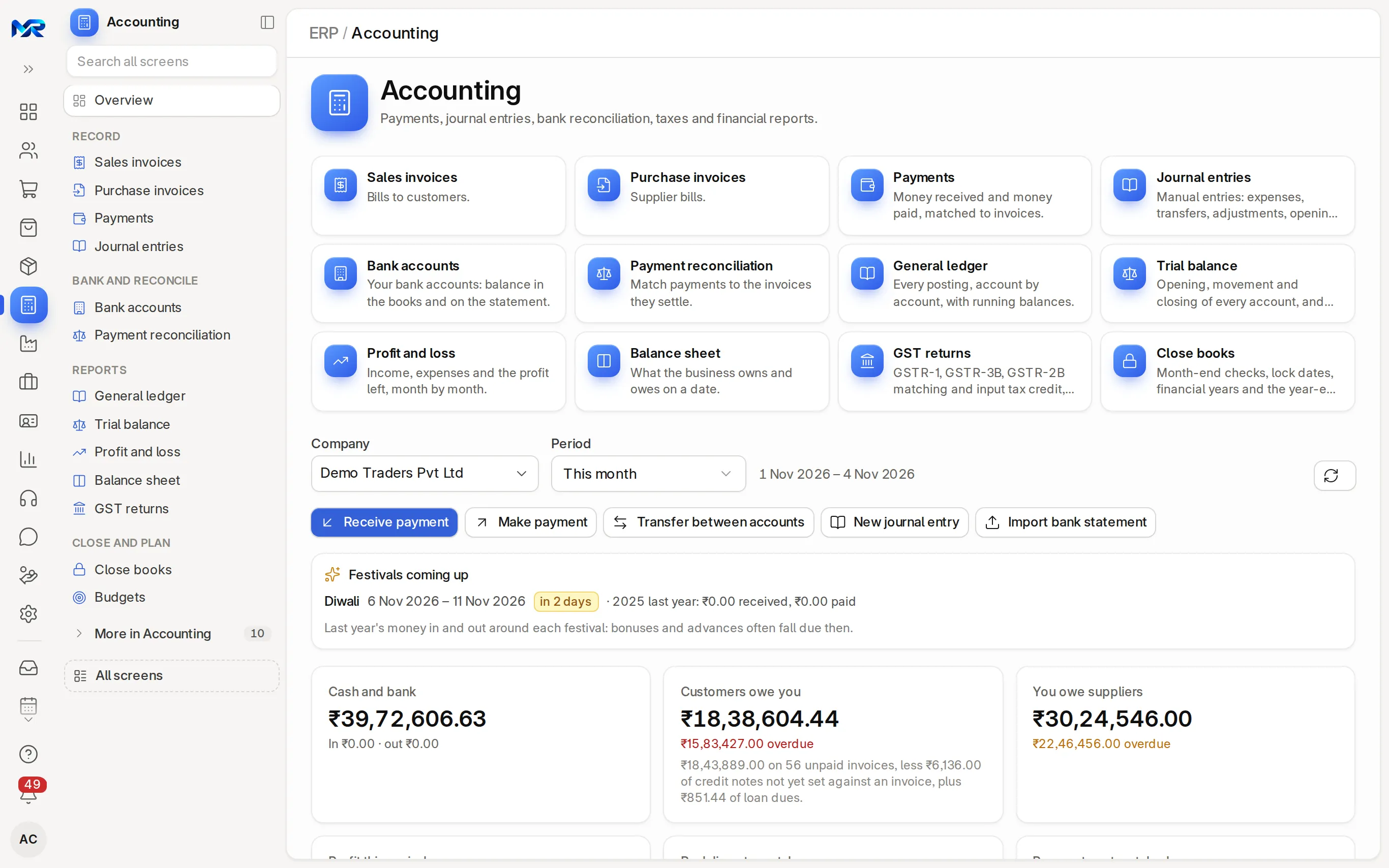
Accounting -
Stock items and BOMs
Stock groups, units, godowns and stock items come in from the Masters file. Opening stock arrives as one draft opening stock count by godown, BOMs as drafts. You check both before they are submitted.
Inventory -
Day Book as journals
The dry run resolves every voucher to accounts and parties and lists each problem, such as an unknown ledger. Fix the masters, run it clean, then import.
Accounting -
Check the totals together
Trial balance, party balances, stock and bank go side by side with Tally. Every difference is explained or fixed before the parallel run.
-
Parallel run, then cutover
You work in both for one to two weeks. When three days in a row reconcile with no manual fix, Tally goes read-only and you work in MyRecords.
- From Tally: Ledgers and balances Sheet becomes Accounts and opening entry Loaded by us from your trial balance
- From Tally: Sundry Debtors and Creditors Masters becomes Customers and suppliers GSTIN carried across
- From Tally: Stock items, units, godowns Masters becomes Items and warehouses With HSN codes
- From Tally: Opening stock Masters becomes Opening stock count A draft, you check it
- From Tally: Bills of materials Masters becomes BOMs Drafts, never auto-submitted
- From Tally: Day Book vouchers Day Book becomes Journal entries Checked first, posted when you confirm; undo cancels them
Then we check the totals with you
- Trial balance
- Party balances
- Stock value
- Bank and cash
Difference, Tally vs MyRecords₹0or explained, before go-live
Tested on Tally's own sample export, not yet on a real company's data. Sales and purchase vouchers come in as journals, without item lines; open bills come in as opening invoices.
Your data
What moves, and how.
Item by item, from Tally to MyRecords. Every file is checked before anything is imported.
| What | How it moves |
|---|---|
| Ledgers and groups | Set up in the chart of accounts with you, under matching groups, before the Day Book comes in. Bank, loan, duties and expense ledgers stay accounts, not parties. |
| Sundry Debtors and Sundry Creditors | Become customers and suppliers, including sub-groups, after a dry run that lists what is new, what already exists and what is not a party. The GSTIN comes from the ledger. |
| Stock items, units and godowns | Stock groups become item groups and godowns become warehouses. Items come in with HSN code and stock unit; units such as Nos or Kgs are matched, not duplicated. |
| Opening stock | Quantity and value by godown become one draft opening stock count for you to check and submit. |
| Bills of materials | Become draft BOMs, never submitted automatically. Components, co-products, by-products and scrap lines are read. |
| Day Book vouchers | Become journal entries, ledger line by ledger line, after a clean dry run. A voucher already imported is skipped if the file comes in again; a wrong batch is undone from the Tally imports log, which cancels its journals and deletes nothing. |
| Opening balances | Ledger balances go in as an opening journal on your opening-balance date, the day before cutover, read from your trial balance and saved as a draft for you to check. Open customer and supplier bills come in as opening invoices, so ageing stays right. |
| Invoices with item lines | Not imported as Tally vouchers yet. Open orders and open bills move through our Excel templates; closed history stays in Tally. |
| Older history | Stays in Tally, which you keep readable for 12 months. Up to five years of history can move at extra cost; see data migration. |
Timeline
Week by week, to go-live.
Nothing goes live until the checks pass and you agree.
-
Week 0
Walk your Tally company and other files. Agree the cutover date (a month start is best) and the opening-balance date.
-
Week 1
Ledgers, parties, stock items and BOMs, in order. Dry run, fix, import.
-
Weeks 1–2
Opening balances, opening stock and Day Book. An accountant reviews a 20-row sample before anything is submitted.
-
Week 2
Reconcile with Tally for the opening-balance date.
-
1–2 weeks
Parallel run until three consecutive days reconcile with no manual fix.
-
Cutover
Final Tally export, the gap imported, a go-live backup kept. Tally stays read-only.
-
Sign-off
A signed one-page record of dates, checks and backups. Support starts here.
Go-live checklist
7 checks, signed off with you
- Trial balance — every ledger's closing balance matches Tally.
- Receivables and payables — totals and ageing, party by party.
- Stock — quantity and value by item and godown.
- Bank and cash — each account matches its statement balance.
- Counts — customers, suppliers, items and employees.
- GSTIN present on every registered party — 100%.
- The comparison sheet, with both columns and the difference, stays on your file.
6 modules
What you run after the move.
Most businesses like this start here. Every module shares one set of books, one login and one list of customers and items.
- Accounting Ledgers, bank reconciliation and financial statements, in your currency.
- India compliance India’s GST, TDS and e-invoice files from your own books.
- Sales Quotation to payment in one connected chain.
- Purchasing Material requests to supplier payments, with AI bill reading.
- Inventory Stock by warehouse, batch, expiry and serial, with reorder alerts.
- Payroll A nine-step pay run; India’s PF, ESI, PT and TDS built in.
Honest fit
When to stay where you are.
We would rather say so now than after you have paid.
Compare the options fairly- A small firm happy with Tally on one PC may be better off staying. Tally Silver is ₹8,100 a year or ₹22,500 one time for a single PC (Tally's price page, checked 1 Nov 2026), and Tally says it is designed to work offline by default.
- If you need GSTR-9 or a TCS return from the same software, stay for now. TallyPrime 7.2 lists GSTR-9 export in its release notes; MyRecords does not prepare these yet.
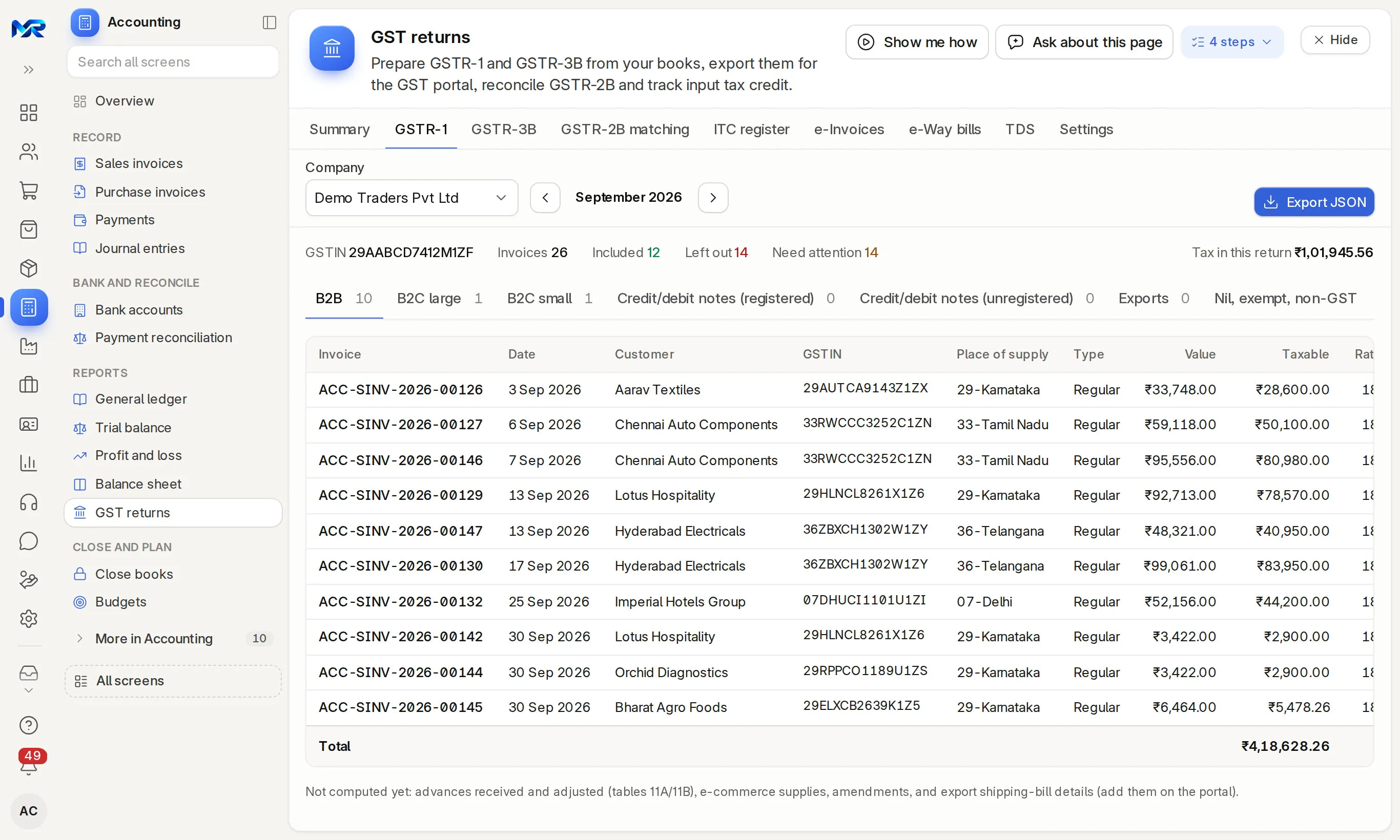
- If you need direct filing on the GST portal from the software today, note that MyRecords prepares GSTR-1 and GSTR-3B files for you to upload; filing from inside MyRecords is not built yet.
- If your sales and purchase invoices with item lines must move as vouchers, wait. That part of the importer is not built yet.
Questions
Questions people ask
Something else on your mind?
Ask us anything about modules, a quote or moving across. A person from our team replies.
Ask a question01Can you move my whole Tally company?
We move your Tally masters, balances and Day Book, and check the totals with you. Parties, stock items with opening stock and BOMs come across from the Masters file, your ledgers are set up in the chart of accounts with you, and Day Book vouchers become journal entries. Sales and purchase vouchers with item lines are not imported as vouchers yet.
02Has the Tally import been used on real company data?
Not yet. It has been tested on Tally's own sample export and on test files built to Tally's format. That is why every step starts with a dry run, an accountant reviews a 20-row sample, and the totals are checked side by side with Tally before go-live.
03What do I need to export from Tally?
Masters and the Day Book, as XML, from Tally's export menu. We show you how in the first week, or do it with you.
04Do I lose my old years?
No. Tally stays readable for 12 months after cutover. Only what is still open moves by default; older history can move at extra cost.
05What if a party is both a customer and a supplier?
If Tally has two ledgers, one under Sundry Debtors and one under Sundry Creditors, both import, as a customer and a supplier. If you keep one ledger for both, it comes in on its group's side and we add the other record by hand.
06Can our CA keep using Tally during the parallel run?
Yes. Purchase bills (Export to Tally on the list), journal entries and the month's pay run can be downloaded as Tally XML and imported into Tally, where ledgers with the same names exist.
07How long does the move take?
About two weeks to a reconciled opening, then one to two weeks of parallel running. The parallel run ends only when three days in a row reconcile with no manual fix.
08What does it cost?
Masters and opening balances from Tally XML are part of the setup fee. One to five years of history can be added, quoted up front by the years you move. See data migration.
09Can my CA still work with us?
Yes. Invite your CA gives them an access pack (Accounts by default, or one you choose) that ends on a date you pick. See for accountants and CAs.
Last updated
Next step
See it on your own numbers.
A live demo on our sample company, shaped to your kind of work, with your questions answered. Or ask us for a quote first.
Live demo
Book a walk-through
- On our sample company, for your kind of work
- A quote for the modules you need
- Your questions, answered by our team