
India compliance
E-way bills, checked before the portal.
The bulk-upload file from your invoices and deliveries, with what the portal would refuse fixed first.
6 of 7 parts work today
Part of India compliance. Outside India, your country pack sets the local tax invoice and the VAT or sales-tax return report; we build and test it before go-live. Your country
How it works3 steps
-
Fill the transport details
Vehicle number or transporter ID, mode, distance and, for rail, air or ship, the transport document. They can be added after the invoice is submitted.
-
Check and download
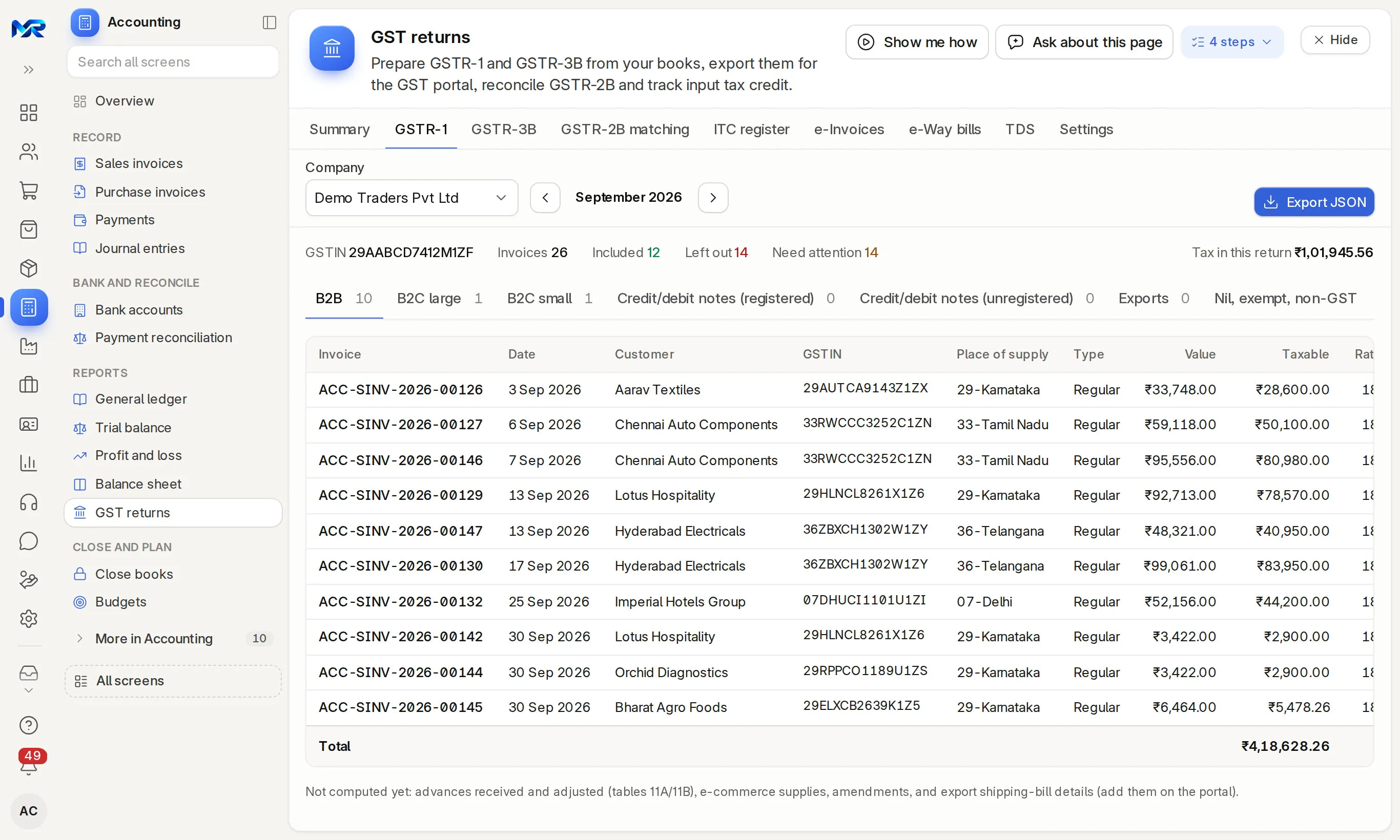
Each document's e-Way bill tab shows a checklist of what the portal needs, with the fix in words. Tick documents in the list and press e-Way bill JSON; those that pass go into one bulk-upload file.
-
Upload and record
Upload the file on the e-way bill portal (e-Waybill › Generate Bulk), then record the 12-digit number and date. The validity is kept with it.
- Users
- Unlimited
- no per-user fee on any module
- Runs on
- Your server
- or a dedicated system on MyRecords Cloud
- Core ready in
- 1–2 weeks
- set up by our team with the modules you pick
In short
MyRecords builds the e-way bill portal's bulk-upload file from submitted sales invoices, deliveries and stock transfers. Before the file is made it checks what the portal needs: GSTINs, 6-digit PIN codes, states, HSN on every line, the document number, distance and vehicle or transporter. You upload the file on the e-way bill portal and record the 12-digit number it returns; MyRecords keeps the validity and lists bills that are expiring. Generating e-way bills on the portal's API is built and works once you connect your e-way bill API login, from NIC or a GSP.
The details
What it covers.
6 of 7 work today
- Works today 6
- Once connected 1
-
When one is neededWorks today
Above a consignment value of ₹50,000 (some states set another limit for moves within the state). The limit is a company setting, and the "Needed, not made" tab lists documents of the last 30 days above it with no e-way bill.
-
Validity by distanceWorks today
One day for up to 200 km and one more day for every further 200 km or part of it (20 km a day for over-dimensional cargo); each day ends at midnight. If you do not enter the portal's validity, MyRecords works it out by this rule.
-
Expiring and expiredWorks today
The e-Way bills tab of GST returns lists them as Active, Expiring in 24 h, Expired and Cancelled, across invoices, deliveries and stock transfers.
-
Checks the portal would refuseWorks today
Your GSTIN and the customer's, 6-digit PIN codes, states, HSN on every line, a document number of at most 16 characters, distance up to 4,000 km, a real vehicle number or a 15-character transporter ID, and documents older than 180 days.
-
Bill-to and ship-toWorks today
When goods go to a different place from the buyer, the file carries the consignee as the portal's bill-to / ship-to type.
-
Remove with a reasonWorks today
Cancel the e-way bill on the portal, then take it off the document with the reason, so the record matches.
-
E-way bills straight from MyRecordsOnce connected
Generate on portal makes the e-way bill, updates the vehicle (Part B), extends validity and cancels it on the portal's API; an invoice with an IRN gets its e-way bill by IRN. They work once you connect your e-way bill API login, through NIC direct access or a GSP.
Said plainly
Not there yet
- Generating, extending or cancelling e-way bills from MyRecords without an API login; until you connect one, you do that on the portal and record the result.
Official sources
- CGST Rules, rule 138 (₹50,000 consignment value; validity of one day per 200 km, or 20 km for over-dimensional cargo), CBIC — Checked 1 Nov 2026.
- Generate e-way bill API (document number up to 16 characters; the 4,000 km distance limit), NIC
- E-way bill release notes (validity changed to 200 km per day, Notification 94/2020), NIC
- E-way bill announcements (180-day document limit and 360-day extension limit from 1 Jan 2025), NIC
Questions
Questions people ask
Something else on your mind?
Ask us anything about it. A person from our team replies.
Ask a question01When do I need an e-way bill?
For moving goods worth more than ₹50,000 in one consignment, under rule 138 of the CGST Rules. Some states set a different limit for moves within the state, so the limit is a setting you can change.
02How long is an e-way bill valid?
One day for up to 200 km, and one more day for every further 200 km or part of it. For example, 365 km gives two days. Each day ends at midnight of the day after the bill was made.
03Can the e-way bill come with the e-invoice?
The e-invoice file carries the transport details, and if the portal's response includes an e-way bill number, MyRecords stores it on the invoice.
04Can I make e-way bills for stock transfers between godowns?
Yes. A move between your own premises under the same GSTIN, or goods sent to a job worker, goes on a delivery challan e-way bill in the same bulk-upload format. A move to your branch with another GSTIN is a supply, so it is billed on a sales invoice and the e-way bill comes from that.
05Is there a limit on how old the document can be?
Yes. Since 1 Jan 2025 the portal does not make e-way bills for documents dated more than 180 days back, and MyRecords flags them. Extensions are limited to 360 days from when the bill was made.
Last updated Facts last verified against the official sources below Applies to MyRecords 3 Nov 2026 release Expert review pending
Next step
See it on your own numbers.
A live demo on our sample company, with our team. Or ask us for a quote first.
Live demo
Book a walk-through
- On our sample company, for your kind of work
- A quote for the modules you need
- Your questions, answered by our team