
What it means
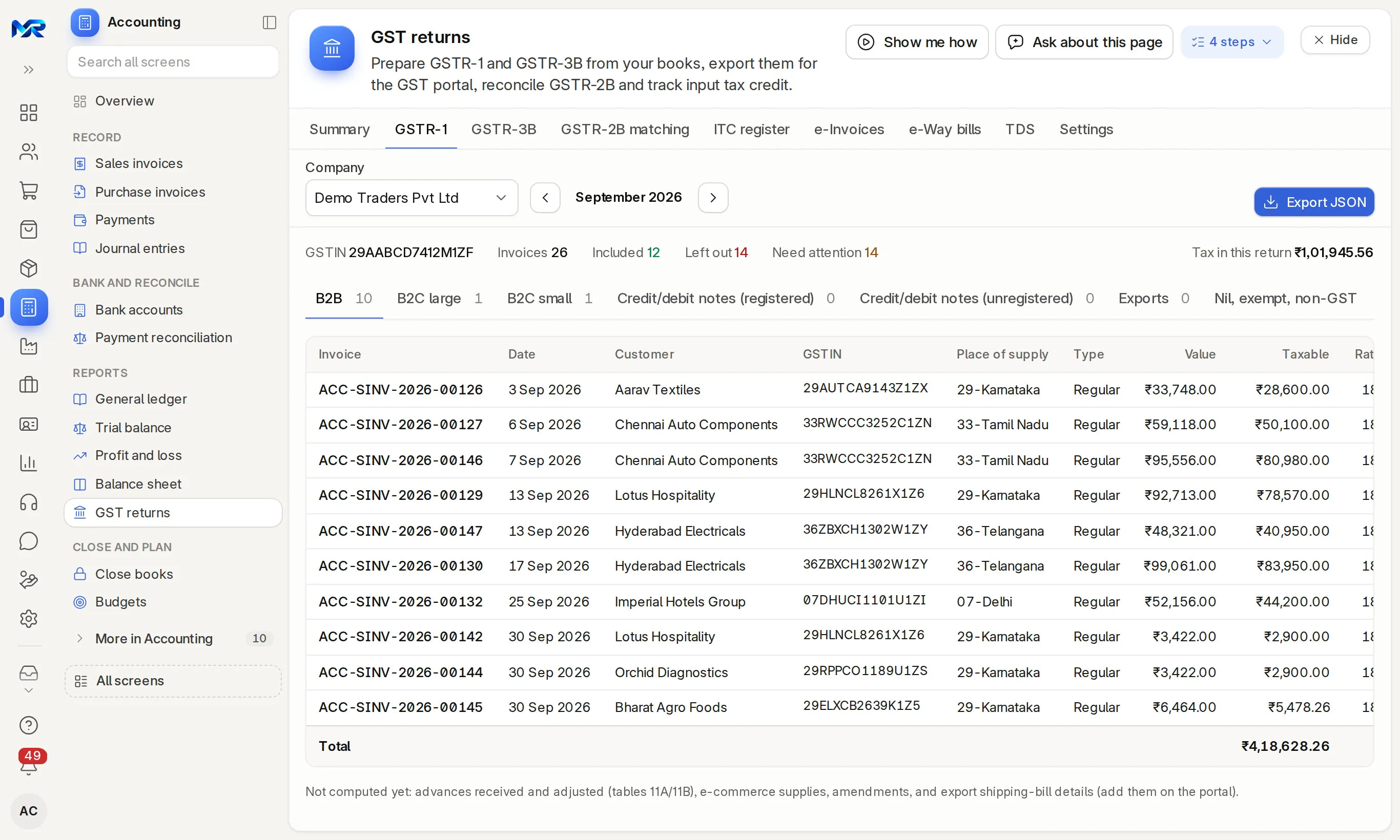
GSTR-1 tells the government, and through GSTR-2B your buyers, what you sold. Monthly filers file it by the 11th of the next month; businesses in the quarterly QRMP scheme file it by the 13th after the quarter. Its main tables:
| Table | What goes in |
|---|---|
| B2B | Invoices to registered buyers, with their GSTIN |
| B2CL | Inter-state invoices to consumers above ₹1 lakh |
| B2CS | Other sales to consumers, summarised by state and rate |
| CDNR / CDNUR | Credit and debit notes |
| EXP | Exports |
| HSN | HSN-wise summary |
| Docs | Number series of documents issued |
Example
Kaveri Agencies files October 2026 by 11 Nov 2026: 84 B2B invoices worth ₹38,40,000, 2 credit notes, and B2C sales of ₹4,15,000 to Karnataka buyers. Its buyers see the 84 invoices in their GSTR-2B for October.
Common mistakes
- Putting a B2B invoice in B2CS because the buyer’s GSTIN was not on the bill; the buyer loses the credit.
- Fixing a GSTR-1 error by typing a different figure in GSTR-3B; correct it in GSTR-1A or the next GSTR-1 instead.
- HSN summary totals that do not match the invoice tables.
In MyRecords
MyRecords prepares GSTR-1 from your books in the GST portal’s offline-tool JSON format, with the B2B, B2CL, B2CS, CDNR, CDNUR, EXP, nil-rated, HSN and document tables, for you to upload. Periods are monthly; the quarterly QRMP option and filing from inside MyRecords are on the roadmap. Advances (11A/11B), e-commerce supplies and amendments are added on the portal.