
What it means
The usual formula is:
Reorder level = average daily usage × lead time in days + safety stock
Lead time is the days between placing an order and the goods being ready to sell. Safety stock covers days when sales run high or the supplier runs late. The reorder quantity is how much you order each time.
Example
Kaveri Agencies sells about 40 boxes of wall plugs a day. Its supplier in Chennai takes 7 days. It keeps a safety stock of 120 boxes.
| Part | Boxes |
|---|---|
| Usage during lead time (40 × 7) | 280 |
| Safety stock | 120 |
| Reorder level | 400 |
When stock in the Mysuru godown falls to 400 boxes, Kaveri orders its standard 1,200 boxes.
Common mistakes
- Setting one reorder level for all godowns when sales differ by branch.
- Never updating the level after a festival season or a supplier change.
- Counting stock already promised to customers as available.
In MyRecords
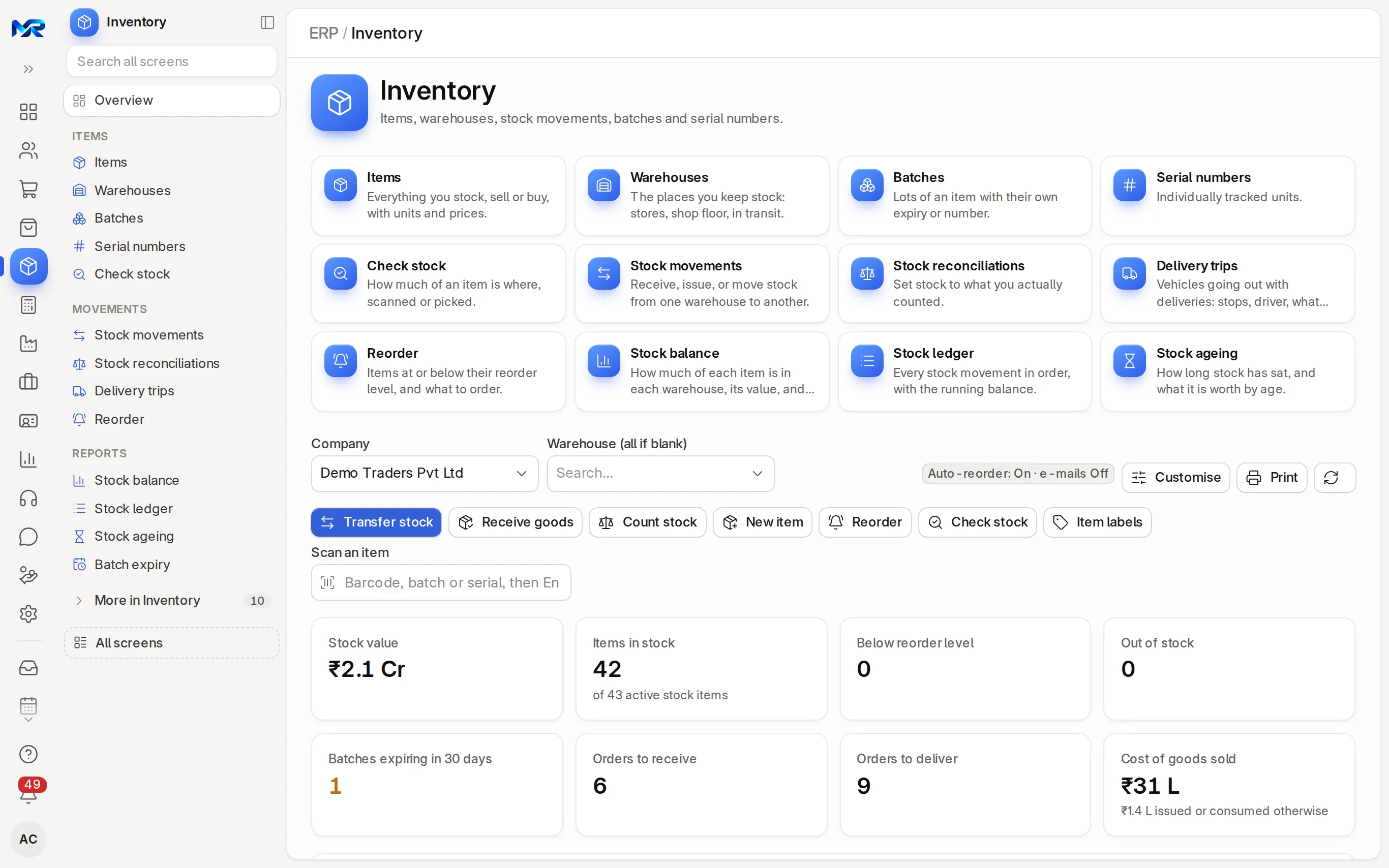
Each item can carry a reorder level and reorder quantity per warehouse, and its page suggests levels from its recent use and lead time. The Reorder page lists each item and warehouse whose projected stock has fallen to its level, with the quantity to order, and makes material requests or purchase orders by supplier; auto-reorder can raise the requests daily. Our free reorder point calculator works out the level from your own figures.