
When you need an e-way bill
A registered person must generate an e-way bill before goods start moving, if the consignment value is more than ₹50,000 and the movement is (CGST rule 138(1)):
- for a supply, such as a sale,
- for reasons other than a supply, such as a branch transfer or sending goods for job work,
- or an inward supply from an unregistered person.
You can make one below ₹50,000 too, if you choose. Rule 138(14) lists cases that need no e-way bill, such as goods in its Annexure and goods moved by a non-motorised conveyance. Check that list for your goods.
Part A and Part B
| Part | What it holds | Who fills it |
|---|---|---|
| Part A | The goods and the document: GSTINs, document number and date, value and HSN | The supplier, recipient or transporter |
| Part B | Vehicle number or transport document number | Whoever arranges the transport |
When Part B can wait. If goods move up to 50 km within the same state, from the consignor’s place of business to the transporter’s place for onward transport, Part B is not needed for that leg. The Part A number stays valid for 15 days for updating Part B.
How long it is valid
| Kind of cargo | Distance | Validity |
|---|---|---|
| Normal cargo | Up to 200 km | 1 day |
| Normal cargo | Every further 200 km or part of it | 1 more day |
| Over-dimensional cargo, or multimodal with a ship leg | Up to 20 km | 1 day |
| Over-dimensional cargo, or multimodal with a ship leg | Every further 20 km or part of it | 1 more day |
A “day” ends at midnight of the day after the e-way bill was generated.
Value test. The ₹50,000 is the consignment value including GST. Goods of ₹45,000 + ₹8,100 GST = ₹53,100 need an e-way bill.
Worked example. Shree Lakshmi Hardware, Bengaluru, sends goods worth ₹2,36,000 (₹2,00,000 + ₹36,000 IGST) to a buyer in Hyderabad, about 570 km away. It generates the e-way bill at 10:00 on 3 Mar.
- 570 km is 200 + 200 + 170, so validity is 3 days.
- Day 1 ends at midnight at the end of 4 Mar. Day 3 ends at midnight at the end of 6 Mar.
- If the truck breaks down, the transporter updates Part B and extends within eight hours of expiry.
Cancelling and closing
- Cancel within 24 hours if the goods did not move or did not move as stated. You cannot cancel one that was verified in transit.
- Voluntary closure. GSTN added a facility to close an e-way bill in specified cases, from 1 Aug 2026.
Portal changes in 2025 and 2026
| From | Change | Source |
|---|---|---|
| 1 Jan 2025 | Documents older than 180 days cannot be used to make an e-way bill | GSTN advisory, 17 Dec 2024 |
| 1 Jan 2025 | Extension limited to 360 days from the day it was made | Same advisory |
| 1 Apr 2025 | Login with username, password and OTP for all users | Same advisory |
| 1 Jul 2025 | E-Way Bill 2.0 portal (ewaybill2.gst.gov.in) works in sync, as a backup for Part B updates and extensions | GSTN advisory, 16 Jun 2025 |
| 1 Aug 2026 | Ship-to GSTIN required in bill-to, ship-to movements (“URP” for unregistered); voluntary closure | GSTN advisories, 9 and 17 Jun 2026 |
| 1 Nov 2026 | Goods moved by metro railway brought into rule 138(2A) with railways | Notification 05/2026-Central Tax |
How MyRecords helps
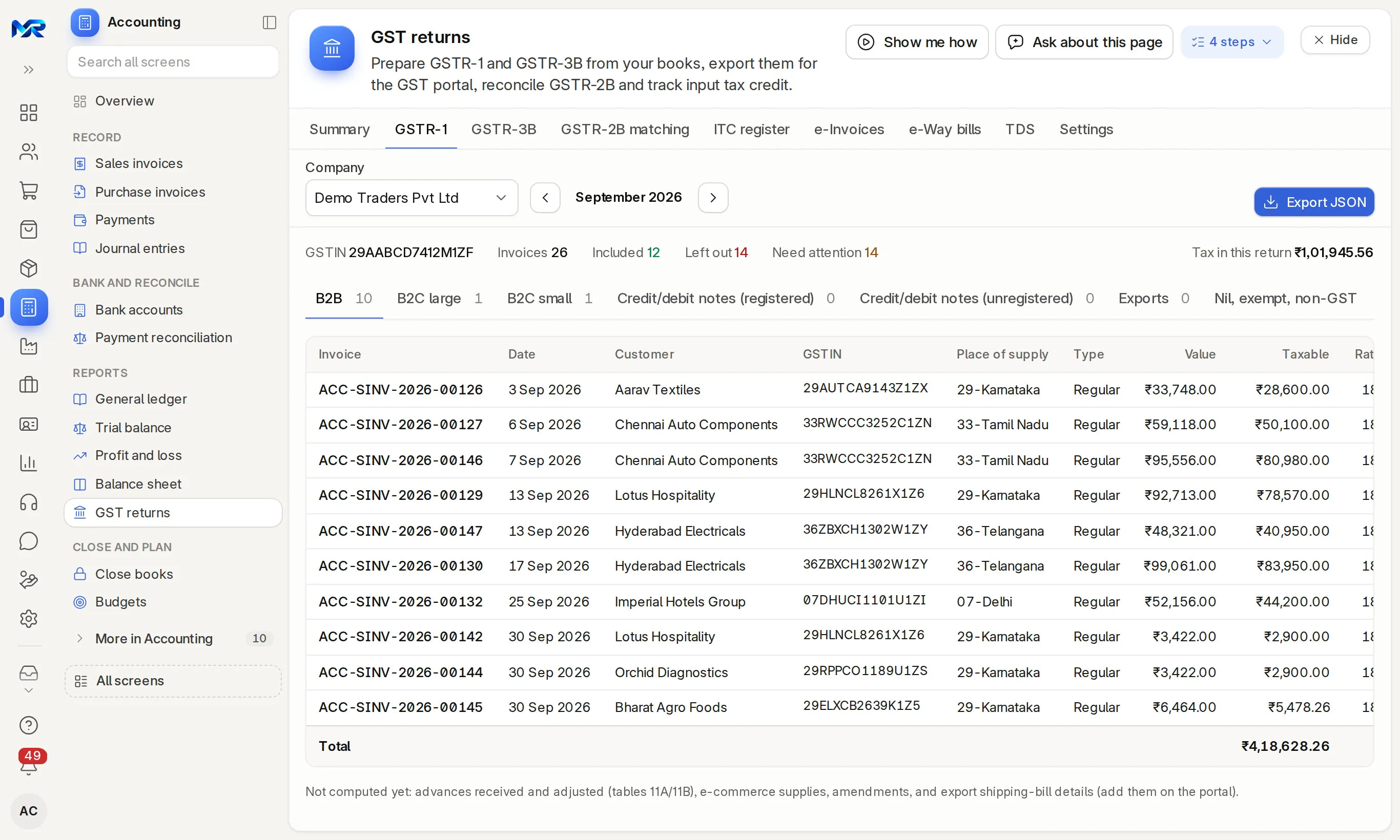
- Makes the bulk-upload file for the e-way bill portal from submitted deliveries, invoices and stock transfers.
- Checks before you upload: GSTINs, PIN codes, states, HSN codes, document number length and transport details, the things the portal would refuse.
- Records the e-way bill number, date and validity on the document, so your team sees which goods are covered.
- API generation, Part B updates, extension and cancellation, through NIC direct access or a GST Suvidha Provider, are built and available once you connect your API login.
See E-way bill in MyRecords. For place of delivery and tax type, read place of supply.